
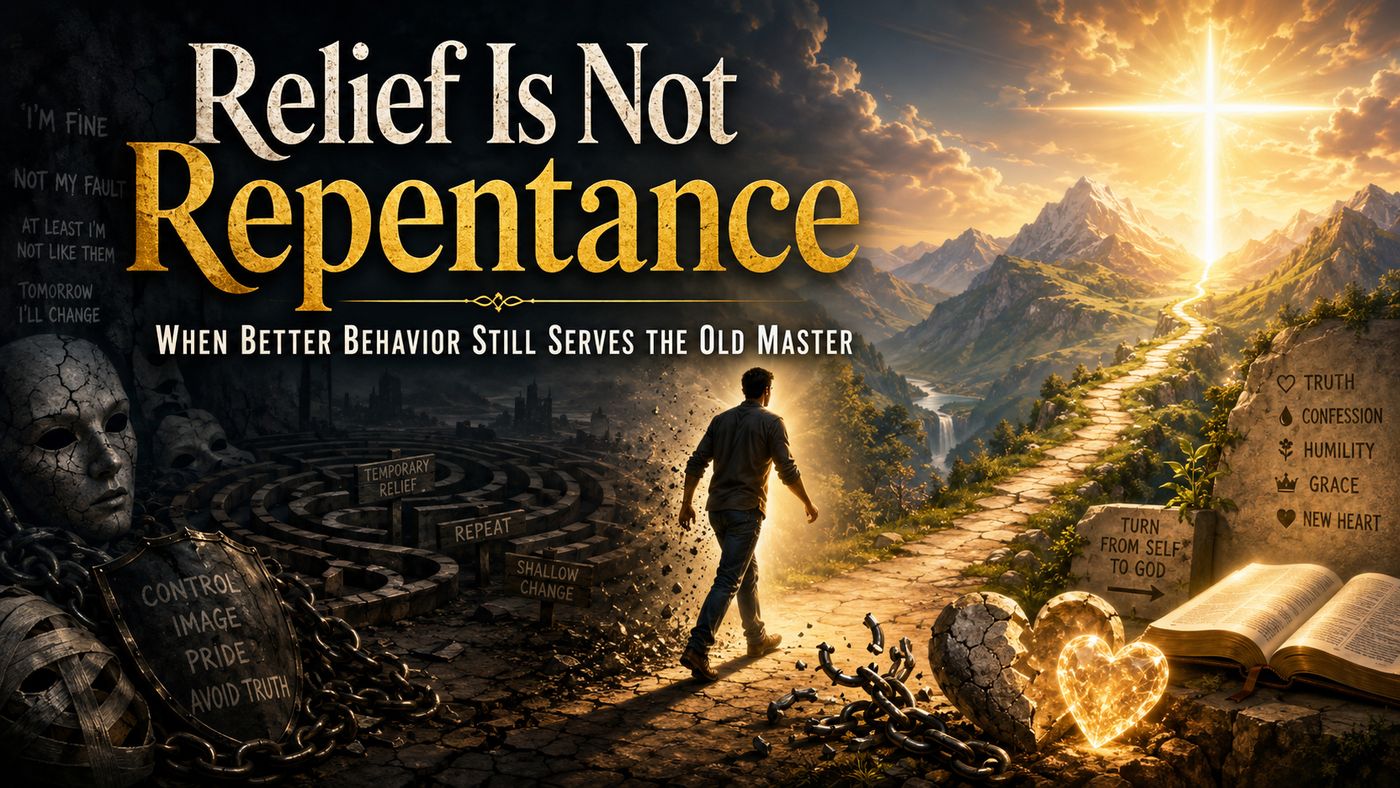
There is a kind of change that looks spiritual at first.
A person is confronted with sin. Consequences begin to close in. Relationships are strained. Trust is damaged. The pressure becomes painful enough that something must change. So they apologize. They soften. They behave better for a season. They may even speak the right language. They may acknowledge that something is wrong.
They may say they want to do better.
And sometimes, for a while, they do.
But Scripture teaches us to look deeper than the behavior itself. The question is not merely, “Did the person choose something better?” The question is, “What master did that choice serve?”
The unconverted heart can choose better behavior when better behavior protects the self. It can choose morality for reputation. It can choose compassion because compassion feels noble. It can choose discipline because discipline keeps life from falling apart. It can choose apology because apology relieves pressure. It can choose religious language because religious language restores image. It can even choose “good” things while still loving the sin that made those choices necessary.
That is why relief must never be confused with repentance.
Relief asks, “How can I escape the pain of my sin?”
Repentance asks, “How can I turn from the sin that dishonors God?”
Relief wants consequences to stop.
Repentance wants rebellion to die.
Relief protects the self.
Repentance brings the self into the light.
And this distinction matters because Scripture does not describe fallen man as morally neutral. Jesus says, “Everyone who commits sin is a slave of sin” (John 8:34). Paul says that before grace we were “slaves of sin” and “slaves of impurity” (Romans 6:17, 19). That does not mean people do not make real choices. They do. But their choices flow from the nature and master that rules them.
Choice is real, but it is never neutral.
A slave of sin may choose relief from consequences, but only grace can give a heart that chooses repentance for the glory of God.
That is why the call of the gospel is not merely, “Make better choices.” It is much deeper and far more desperate than that. The call is, “Come to Christ. Go to the cross. Plead for mercy. Stop hiding. Stop negotiating. Stop trying to manage the damage while preserving the sin. Your only hope is not that you become better at repairing your life. Your only hope is that God gives you life.”
When Knowledge Does Not Become New Life
One of the most dangerous places a person can stand is near enough to truth to speak it, but far enough from grace to remain unchanged by it.
A person can know theology and still be enslaved to sin. A person can explain doctrine and still be building his own kingdom. A person can defend truth with his mouth while refusing to bow beneath it with his life.
This is not because theology is bad. Good doctrine is a gift from God. Truth matters. The mind matters. Scripture commands us to know, think, discern, and grow. But knowledge that does not become repentance while refusing to surrender to the Word.
Jesus gives an even heavier warning in Matthew 7. There are people who say, “Lord, Lord,” and yet hear the words, “I never knew you; depart from Me, you lawbreakers” (Matthew 7:21–23). Notice what Jesus does not say. He does not say they were irreligious. He does not say they had no spiritual language. He does not say they were far from holy things. They were close enough to say “Lord,” but still unknown by Christ.
That should sober us.
Being around truth is not the same as being changed by truth. Speaking about Christ is not the same as belonging to Christ. Knowing doctrine is not the same as being made new.
The issue is not whether a person can choose something that looks better for a while. The issue is what that choice is serving. Is it serving Christ, or is it serving the self? Is it born from faith and repentance, or is it another way to manage consequences and preserve control?
A sinful heart can make “good” choices for sinful reasons. It can choose honesty because lies were exposed. It can choose kindness because cruelty became costly. It can choose responsibility because irresponsibility threatened comfort. It can choose compassion because compassion feels like proof of goodness. It can choose religion because religion repairs image.
But none of that, by itself, proves new birth.
Only grace can create a heart that wants God Himself. Only grace can make sin bitter because it dishonors the Lord, not merely because it made life painful. Only grace can make repentance more desirable than relief.
Relief Can Imitate Repentance
Paul gives us one of the clearest distinctions in 2 Corinthians 7:10:
“Godly grief produces a repentance that leads to salvation without regret, but worldly grief produces death.”
Both kinds of sorrow can look emotional. Both may involve tears. Both may sound sincere in the moment. Both may lead to some kind of change. But they do not come from the same place, and they do not lead to the same end.
Worldly grief is sorrow over consequences. It grieves exposure, embarrassment, loss, pressure, discipline, broken trust, and the pain sin has created. It may hate what sin has cost, but it does not yet hate sin because sin is rebellion against God.
Godly grief is different. Godly grief sees sin vertically before it sees it horizontally. Like David in Psalm 51, it says, “Against You, You alone, I have sinned and done this evil in Your sight.” David had sinned against people grievously, but he understood that all sin is first and highest against God.
That is the difference between relief and repentance.
Relief says, “How can I make this stop?”
Repentance says, “How have I sinned against God?”
Relief wants pain removed.
Repentance wants the heart cleansed.
Relief wants consequences managed.
Repentance wants rebellion crucified.
Relief may change behavior for a season, but repentance changes allegiance.
This distinction matters because pride often hides beneath the desire for relief. Pride does not always look loud. Sometimes pride looks wounded. Sometimes it looks defensive. Sometimes it looks like self-protection. Sometimes it quietly builds a wall so the heart does not have to feel the pain of truth.
Most of us know something of this.
There are times when pride has kept us from receiving correction, learning from someone wiser, confessing weakness, or admitting that another person had something to teach us. Pride promises to protect us from humiliation, but it usually robs us of grace. It can damage friendships, stunt growth, and keep us from the very help God placed near us.
That is what self-protection does. It gives relief for a moment, but it costs life in the long run.
And if pride can hinder ordinary human relationships, how much more dangerous is pride when a sinner stands before a holy God?
The gospel does not invite us to preserve our image. It calls us into the light. It calls us to stop hiding, stop excusing, stop bargaining, and stop trying to save face. It calls us to Christ.
And yet, apart from grace, the sinner does not naturally come into the light. Jesus says in John 3:19–20 that people loved darkness rather than light because their deeds were evil. Everyone who does wicked things hates the light and avoids it, so that his deeds may not be exposed.
That is why repentance is not merely a human improvement project. Repentance is a miracle of grace.
The unconverted person can be commanded to repent, and he is responsible to repent. But the heart that truly repents must be granted life by God. Paul says that God may grant repentance leading to the knowledge of the truth, so that people may come to their senses and escape the trap of the devil (2 Timothy 2:25–26).
So the call is not, “Wait until you feel able.”
The call is, “Choose repentance over relief, and beg God for the mercy of a heart that can truly desire it.”
Go to the cross. Plead for mercy. Ask God not merely to remove the pain, but to change the heart. Ask Him not merely to repair the consequences, but to expose the sin. Ask Him not merely to give better behavior, but to give new life.
The Freed Heart Can Face the Truth
The gospel does not set us free to live for ourselves. It sets us free from sin so we can live for Christ.
That freedom is not independence from God. It is belonging to the right Master.
Romans 6 says, “Having been set free from sin, you became enslaved to righteousness” (Romans 6:18). That language sounds strange to modern ears because we think freedom means belonging to no one. But Scripture teaches something different. We are never truly our own. We are always serving someone or something.
Before grace, we were slaves to sin.
After grace, we belong to Christ.
That changes everything about sanctification.
The believer still faces sin. He still faces temptation. He still faces mountains, valleys, giants, fears, griefs, and painful obedience. But he no longer faces them as someone trying to save himself. He faces them as someone already held by Christ.
That is why repentance becomes possible in the Christian life. Not easy, but possible. Not painless, but safe.
The Christian can face the truth because the truth cannot condemn him in Christ. The Christian can confess sin because his righteousness is not built on pretending. The Christian can be humbled because his identity is not held together by pride. The Christian can walk into painful obedience because even if obedience costs him comfort, approval, reputation, relationships, or life itself, it cannot take him out of Christ’s hand.
Jesus says, “I give them eternal life, and they will never perish. No one will snatch them out of My hand” (John 10:28).
Paul says nothing can separate us from the love of God in Christ Jesus our Lord (Romans 8:39).
That assurance does not make repentance unnecessary. It makes repentance possible.
The lost heart runs to relief because it is trying to save itself.
The converted heart can run to repentance because it has already been saved by Christ.
This is why sanctification is not merely behavior modification. Sanctification is the life of Christ pressing deeper into every part of us. It is God teaching His children to bring the whole self into the light: our motives, fears, habits, desires, defenses, relationships, ambitions, and hidden loves.
Sometimes that process feels small. A quiet apology. A private confession. A habit surrendered. A conversation handled differently. A moment of restraint when the old self wanted control.
Sometimes it feels like a mountain. A sin pattern exposed. A relationship broken open. A truth we avoided for years. A valley we did not choose and cannot escape.
But whether the obstacle is small or great, the believer’s confidence is the same: this cannot remove me from Christ. God may use this to humble me, but He will not use it to abandon me. He may expose me, but only to heal me. He may discipline me, but as a Father disciplines a son.
Hebrews 12 teaches that God’s discipline is not the rejection of His children but proof of His fatherly love. He disciplines us “for our benefit, so that we can share His holiness” (Hebrews 12:10).
That means the believer does not have to fear the truth the way he once did. The truth may hurt, but it is not an enemy. Exposure may humble, but it is not destruction. Repentance may feel like death to the old self, but it is life in the hands of Christ.
How We Pray for People Caught in Relief
When we see someone choosing relief instead of repentance, we must be careful.
We should not become cruel. We should not speak as though we can see everything God sees. We should not pretend that every moment of struggle means someone is unconverted. Believers can be weak. Believers can be immature. Believers can resist conviction for a season. Believers can need correction, patience, discipline, and restoration.
But we also must not confuse temporary improvement with conversion.
We must not comfort someone in worldly sorrow as though it were godly repentance. We must not tell people they are spiritually safe merely because they want consequences to stop. We must not mistake religious language, theological knowledge, emotional sorrow, or temporary obedience for the new birth.
So how should we pray?
We pray first for mercy.
Lord, grant repentance.
Lord, give them a new heart.
Lord, make sin bitter and Christ beautiful.
Lord, do not let them settle for relief when they need resurrection.
Lord, expose worldly sorrow for what it is.
Lord, bring them into the light.
Lord, free them from the trap of the devil.
Lord, do not let them mistake temporary behavior change for saving grace.
Lord, humble them without destroying them.
Lord, save them.
And when we pray for believers, we pray with the same dependence on grace.
Lord, show me where I am choosing relief over repentance.
Lord, reveal where pride is protecting me from truth.
Lord, give me courage to face what You are exposing.
Lord, teach me to obey as someone held by Christ.
Lord, make me quick to confess, quick to repent, quick to forgive, and quick to walk in the light.
Lord, do not let me use theology to hide from obedience.
Lord, make my knowledge become worship, humility, and love.
That kind of prayer keeps us from pride. It reminds us that none of us repented because we were wiser, softer, stronger, or more spiritually reasonable than someone else. We repented because God had mercy. We came into the light because grace opened our eyes. We chose Christ because Christ first claimed us.
Conclusion: Choose Repentance, and Beg for Mercy
Relief is not repentance.
Relief may want the pain to stop while the heart still loves the sin. Relief may choose better behavior while still serving the old master. Relief may sound humble when pressure is high, but once the pressure fades, the heart returns to what it truly loves.
Repentance is different.
Repentance is not merely wanting a better life. It is turning from sin to God. It is not merely sorrow over consequences. It is grief before the Lord. It is not merely behavior repair. It is the fruit of grace in a heart being made new.
So yes, choose repentance over relief.
But do not trust your own heart to make itself new.
Go to Christ. Plead for mercy. Ask God for the heart only He can give. Ask Him to make sin bitter, Christ beautiful, truth welcome, pride hateful, and repentance precious.
Because the sinner’s hope is not that he can finally manage his life.
The sinner’s hope is that Jesus Christ saves slaves.
And if the Son sets you free, you really will be free.
-Justin Reed
Brushwood Press