
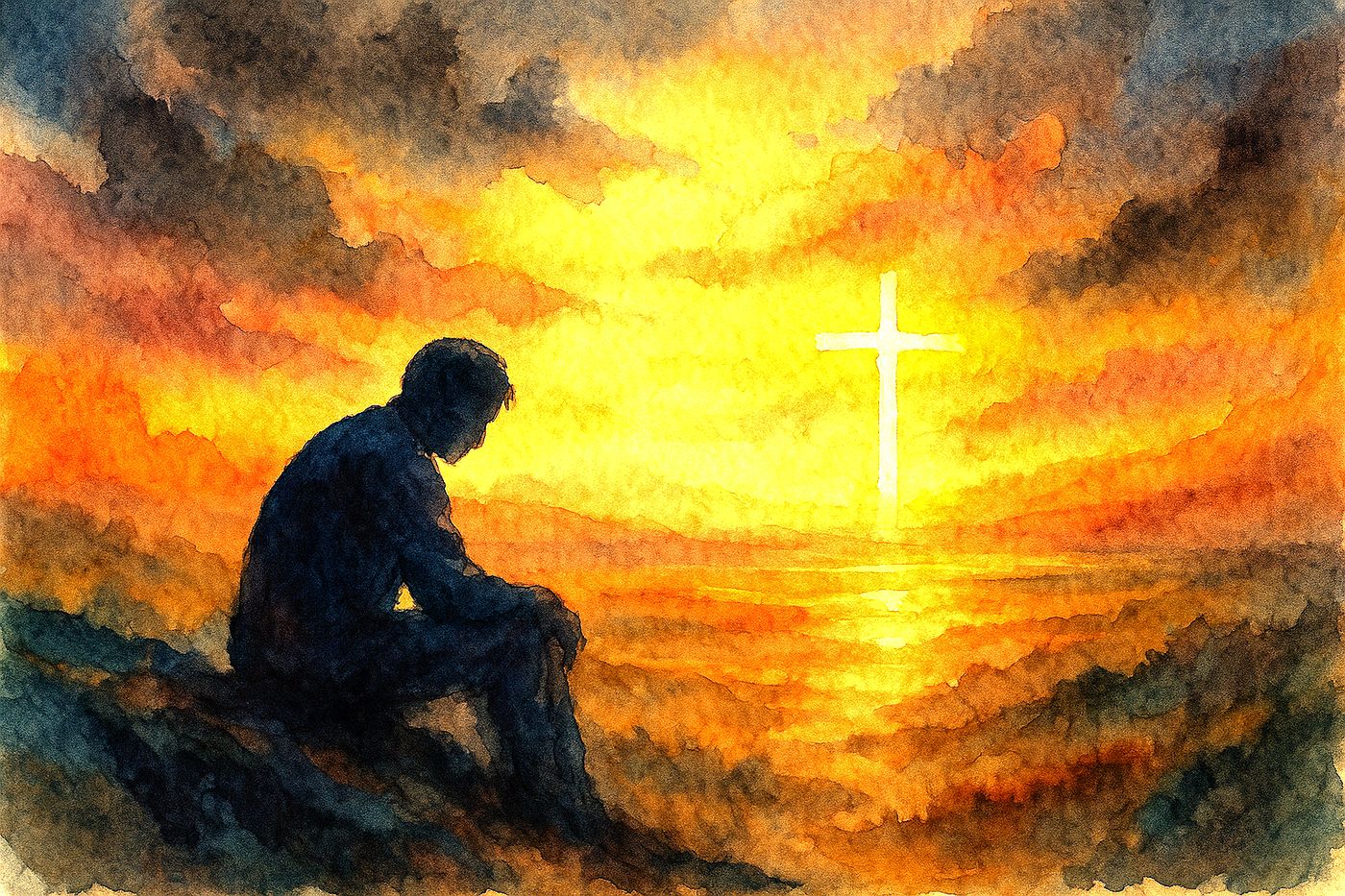
Before we move forward, we need to clarify something from last week—not because the gospel was misstated, but because the contrast must be sharper if we’re going to feel the full weight of Scripture.
When we spoke about Creation, the intention was never to suggest that humanity is inherently good in our present state. Scripture is clear: God alone is good. Humanity was created good only because we bore His image and lived in complete dependence on Him. That goodness was borrowed, contingent, and sustained entirely by God’s presence. Once that relationship was broken, that goodness did not remain intact.
The Fall was not a collection of bad choices layered onto an otherwise neutral humanity. It was the collapse of the human condition itself. The entire race fell. We are not sinners merely because we commit sins; we commit sins because we were born into a fallen, darkened creation. Our sin is not the root of the problem—it is the evidence of it.
Scripture calls this being “dead in sin,” “hostile to God,” and “by nature children of wrath.” That language is heavy, but it is necessary. If sin is treated merely as behavior, the gospel sounds like a hand up. But if the Fall is understood as total—affecting our nature, our desires, and our will—then the gospel becomes what it truly is: a rescue of the dead, not an improvement of the struggling.
This is also why the cross cannot be softened. God did not withhold His wrath even from His own Son when Christ stood in our place. Wrath was not avoided; it was absorbed. Justice was not ignored; it was satisfied. Only then does grace become real.
With that foundation in place, we can now speak honestly about something Scripture never hides from us.
Even after rescue, the waiting still hurts.
The Ache Scripture Actually Names
“Hope deferred makes the heart sick.”
Scripture does not rush past that sentence. It does not correct it. It does not rebuke it. It names something real. Waiting hurts. Disappointment hurts. Longing that stretches across time produces a sickness of heart, and the Bible is not embarrassed to say so.
But here’s where clarity matters: not all hope is the same.
Before Christ, we were described as “without hope and without God in the world.” That does not mean we felt no desire or expectation. It means we had no biblical hope—no anchor, no certainty, no promised end. What we called hope was often just a wish for control, relief, or escape.
The unregenerate person does not truly hope toward God. They hope toward outcomes. Toward comfort. Toward resolution on their terms. When those things are delayed or threatened, the heart becomes sick because it is anchored in uncertainty and fear.
That kind of sickness is anxiety.
But Christian hope is different.
Our hope is no longer aimed at circumstances—it is anchored in a Person. We no longer hope that things might work out; we hope because something has already been secured. And that changes the nature of waiting entirely.
If your hope were merely circumstantial, would the waiting hurt this deeply? Or is the ache itself evidence that your longing is now tied to something eternal?
Application (Rhythm One)
Ask yourself honestly what your hope is attached to when waiting hurts.
Notice whether your ache is rooted in uncertainty or in longing for something you know is real.
Bring that ache to God without apologizing for it. Scripture gives you language for it.
The Pain of the Already and the Not Yet
As believers, we already belong to Christ. We are justified, reconciled, adopted, and clothed in His righteousness. Our standing before God is complete. That is settled, immovable, and secure.
And yet, we are not home.
We are not glorified. We are not free from corruption. We are not in unveiled communion with our Father. Scripture describes this tension as living in the already and the not yet. Salvation is complete, but restoration is not finished.
Romans 8 says that we groan inwardly as we wait.
That groaning is not unbelief. It is not dissatisfaction with God. It is not a failure to trust. It is the sound of love stretched across distance. It is homesickness, not abandonment.
Here is the paradox that often surprises people: hope deferred hurts more after regeneration, not less.
Before Christ, we waited in fear—What if this never comes?
After Christ, we wait in certainty—I know this will come, but not yet.
The sinner’s ache comes from insecurity.
The Christian’s ache comes from assurance.
That is why Scripture says “hope that is seen is not hope.” Biblical hope is not fragile optimism; it is future-oriented certainty. And certainty makes longing sharper, because now the heart knows what it is missing.
Strong faith does not numb the heart. It awakens it.
Christianity is not stoicism. It does not teach us to deny pain. It teaches us to locate pain correctly.
Application (Rhythm Two)
Reflect on where you feel the tension between what you know is true and what you are experiencing.
Read Romans 8 slowly and notice how assurance and groaning sit side by side.
Resist interpreting discomfort as spiritual failure. Scripture frames it as longing.
Held While We Wait
This is where theological clarity protects us from despair.
Trials do not perfect us in ourselves. We are not being improved into righteousness. Our standing before God does not rise and fall with circumstances. It is already complete in Christ by His righteousness imputed to us.
Suffering does not add to our acceptance. Waiting does not earn favor. Pain does not cleanse guilt.
What trials do is expose what we were leaning on.
They strip away false supports. They reveal where our hearts had quietly attached themselves to something other than Christ. And in that exposure, God does not withdraw—He draws closer.
We are not perfected by suffering. We are held in it.
This is why the ache remains even when faith is strong. Christianity does not promise escape from the weight of waiting. It promises presence within it.
Scripture also speaks of the joy of the Lord as our strength. That joy is not the absence of pain. It is the sustaining presence of Christ while the season remains unresolved. Joy, in this sense, is endurance—not denial.
Many believers feel ashamed for struggling in seasons of waiting. They assume something must be wrong with their faith. But Scripture gives us better language:
This hurts.
And God is still here.
The church is meant to be the place where we walk through that tension together—not rush each other past it, not silence it with platitudes, not confuse honesty with weakness.
Application (Rhythm Three)
Identify one place where you’ve been trying to escape discomfort instead of enduring it with Christ.
Pray honestly—not for immediate resolution, but for nearness.
If someone else is waiting, practice presence instead of fixing.
Bringing It All Together
The gospel clarifies our standing before God completely. We were dead, condemned, and without hope—and Christ absorbed the wrath we deserved so we could be reconciled forever.
That clarity does not remove the ache of waiting. It gives it meaning.
Hope deferred does make the heart sick. Scripture says so. But for the Christian, that sickness is not empty. It is not lonely. It is not without direction.
It is held.
It is accompanied.
It is sustained by a Savior who has not abandoned us, even while we wait for what has not yet come.
The unregenerate waits in fear.
The believer waits in love.
The gospel does not remove the weight of waiting. It anchors us beneath it.
And that is where real hope lives.
-Justin Reed
Brushwood Press